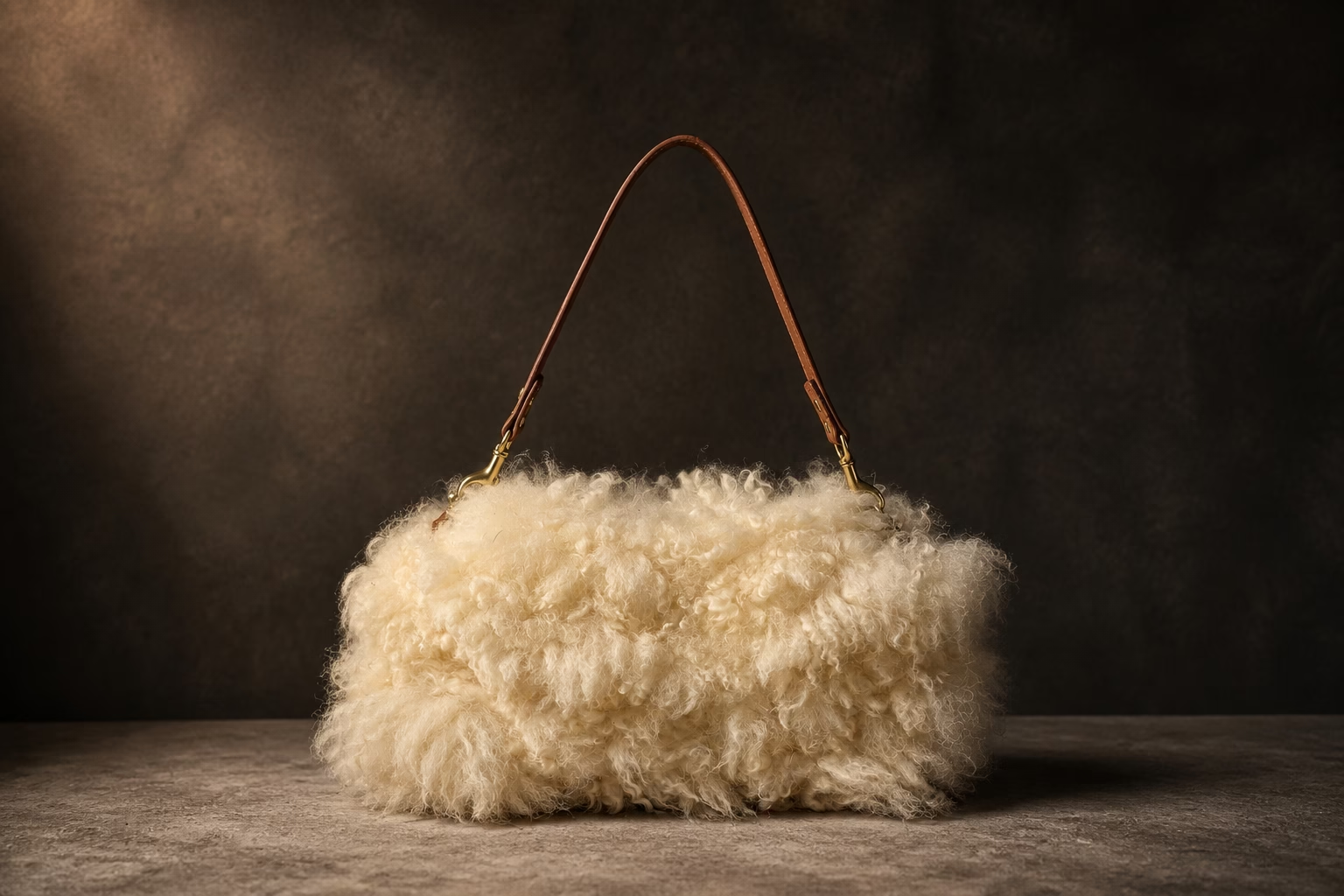
When people imagine an artist's studio, they often picture shelves lined with paint—rows of colors waiting to become a landscape, a portrait, or an abstract work.
My studio has shelves too.
But instead of tubes of paint, they're filled with fleece.
Romney. Icelandic. Navajo Churro. Wensleydale. Gotland. Border Leicester. Alpaca.
To someone unfamiliar with wool, it may all look the same. To me, every breed offers a different vocabulary of texture, structure, movement, and possibility.
Just as a painter reaches for ultramarine instead of cobalt blue, I begin by choosing the fleece that best suits the work I want to create.
But choosing the breed is only the beginning.
I spread the fleece across my table and begin looking, lock by lock.
I study the crimp, staple length, luster, strength, and handle of the wool. I separate locks, compare them, and begin to understand what this particular fleece has to offer.
Then I make another discovery.
Even within a single fleece, the wool isn't uniform.
The shoulder produces one kind of lock. The neck another. The britch another still. Some sections are finer, others stronger. Some have beautiful, flowing locks that are perfect for the flap of a handbag. Others create bold texture or become the foundation of an entirely different piece.
I don't simply choose a fleece.
I choose from within the fleece.
That quiet process of observation is one of my favorite parts of creating.
Long before I begin laying locks or drafting a pattern, the wool has already influenced dozens of creative decisions.
People often ask how I create one-of-a-kind work.
The answer isn't that I set out to make every piece different.
Nature has already done that.
Every sheep grows a fleece unlike any other. Even the same sheep produces subtle variations across its body. Seasons, weather, pasture, genetics, age, and health all leave their mark.
That means I can create three handbags from a single fleece…
…and each one will still have its own character.
The locks may flow differently across the surface. The texture may become softer or more sculptural. The way the light catches the wool changes. The personality of the piece changes.
That is one of the things I love most about working with wool.
It never asks me to repeat myself.
Perhaps that's why I never think of wool as simply a material.
It is my palette.
And every fleece offers a different way of seeing.
~ Karen